 Skip to content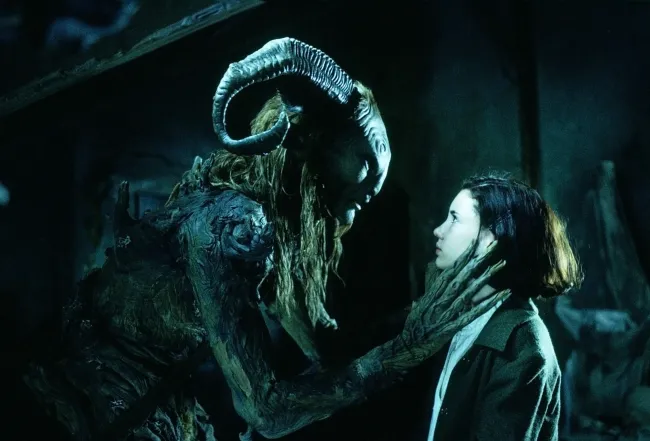
20 years ago, Guillermo del Toro wrote and directed “Pan’s Labyrinth,” an unconventional mix of Spanish history, political commentary, and fantasy aimed at children but with a terrific sense of horror aimed at adults. The story of a young girl (Ivana Baquero) on a mythical journey just after the Spanish Civil War, “Pan’s Labyrinth” was a hit with both critics and audiences thanks to its strong mix of beauty and brutality and its lush, vivid imagery.
One might think that any attempt to improve or change these images would be a fool’s errand, but now del Toro and a team of trusted collaborators have created a 3D version of the film with a new color level and sound mix that gives “Pan’s Labyrinth” an even more immersive quality than before. Opening in North American theaters on October 9 (del Toro’s birthday), the 3D version preserves the spirit and emotional impact of del Toro’s film made 20 years ago while taking advantage of several technological advances that have occurred in the years since.
According to sound editor and designer Scott Gershin, the guiding principle was to modernize the film while remaining faithful to del Toro’s original vision—a task made easier by del Toro’s close involvement and oversight of the project. “If you’re restoring a Model T, you get Model T parts,” Gershin told IndieWire. “You can’t find Model T parts.” Gershin started by accessing some elements and deriving from the original mix, which he found to be a bit dated by 2026 standards.
“The digital technology that was being used at the time definitely had its own sound,” Gershin said. “From a sonic perspective, we wanted the film to be the film for you thought you heard 20 years ago. We didn’t want to add much.” The fact that del Toro was converting the film to 3D, however, affected the sound as well as the image; Gershin realized that with the added visual depth came the need for expanded sound to fill the space.
“When Guillermo first contacted me, I didn’t even know it was going to be in 3D,” says Gershin. “He said, ‘Listen, would you be willing to go back to the film and update it, make it a little more dramatic?’ Then I saw the 3D, and it looked amazing. I realized we had to increase the audio level to match the picture.” To that end, Gershin added more background and foley, adding details and tracking a pass in Dolby Atmos, while being careful not to betray the intentions of the original work.
“It got to the point where we forgot what was original and what was new,” Gershin said. “A lot of the sounds we used were the sounds of the era. The cars at the beginning didn’t play at all before; now the cars come in, and they’re a bit rusty; they look like the cars of the time.
For Aaron Parry of SDFX Studios, who oversaw the 3D conversion of the film, the sole intention was to expand on it rather than recreate the original style. “A lot of times, when a movie is upgraded to 3D, they smooth it out, or upgrade it so it looks good on an 8K TV,” Parry told IndieWire. Del Toro was confident that the texture and grain of the original film, which was shot on film, would remain. “He really wanted to say, this is the movie, but playing it in 3D is going to add so many more layers of fear and anxiety and mystery. So we worked really hard to be non-destructive and preserve everything.”
Parry had worked with del Toro on the director’s 3D storytelling debut, “Pacific Rim,” and felt that “Pan’s Labyrinth” lent del Toro’s interest in the form. “A lot of people think of 3D as something you put on an action movie,” Parry said. “But fantasy and drama play so well with a dimensional approach. ‘Pan’s Labyrinth’ made a lot of sense, because you have the real world and the fantasy world, and we can use 3D to separate those story points and tell the story in a new and heightened way. Guillermo just wanted to bring people deeper into the story, and I think 3D was his solution.”
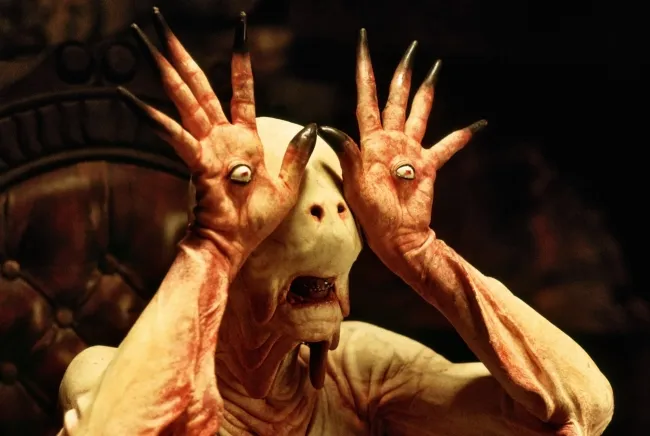
Colorist Stefan Sonnenfeld, like Parry and Gershin who is a longtime collaborator of del Toro’s, noted that while the new version of “Pan’s Labyrinth” is largely a new and improved version of the original, there were places where the filmmakers made mistakes that have always bothered del Toro. “Guillermo had several hot spots in the movie that he never got to talk about,” Sonnenfeld told IndieWire. “Part of that had to do with technology, in terms of raw visual effects, and part of it had to do with the tools available at the time. We touched some of those scenes with the tools we have now that are common, everyday.”
To that end, Sonnenfeld suddenly “massa” some shots that did not fit and mixed the visual effects to look more accurate in the context of the overall film. “With older films, you don’t convert them, but you try to take out some of the roughness so that you feel that there is a benefit when you restore; it’s not just a reproduction,” said Sonnenfeld. “The advantage is in advanced color and shape, and Guillermo had a very good sense of the things that bothered him that he wanted to improve and the areas where he wanted to make sure that we preserved everything.”
Gershin, Parry, and Sonnenfeld agreed that outside of the work itself, the biggest joy of the “Pan’s Labyrinth” project was just hanging out with del Toro. “Guillermo is one of the kindest, most generous, most intellectual people to ever sit in my room,” Sonnenfeld said. “That’s what’s important to me these days. I really want to spend time with someone I’m interested in who values filmmaking, values art and empowers all of us to do what we do.”
The new 4K remake of “Pan’s Labyrinth” opens in theaters on October 9.
