 Skip to content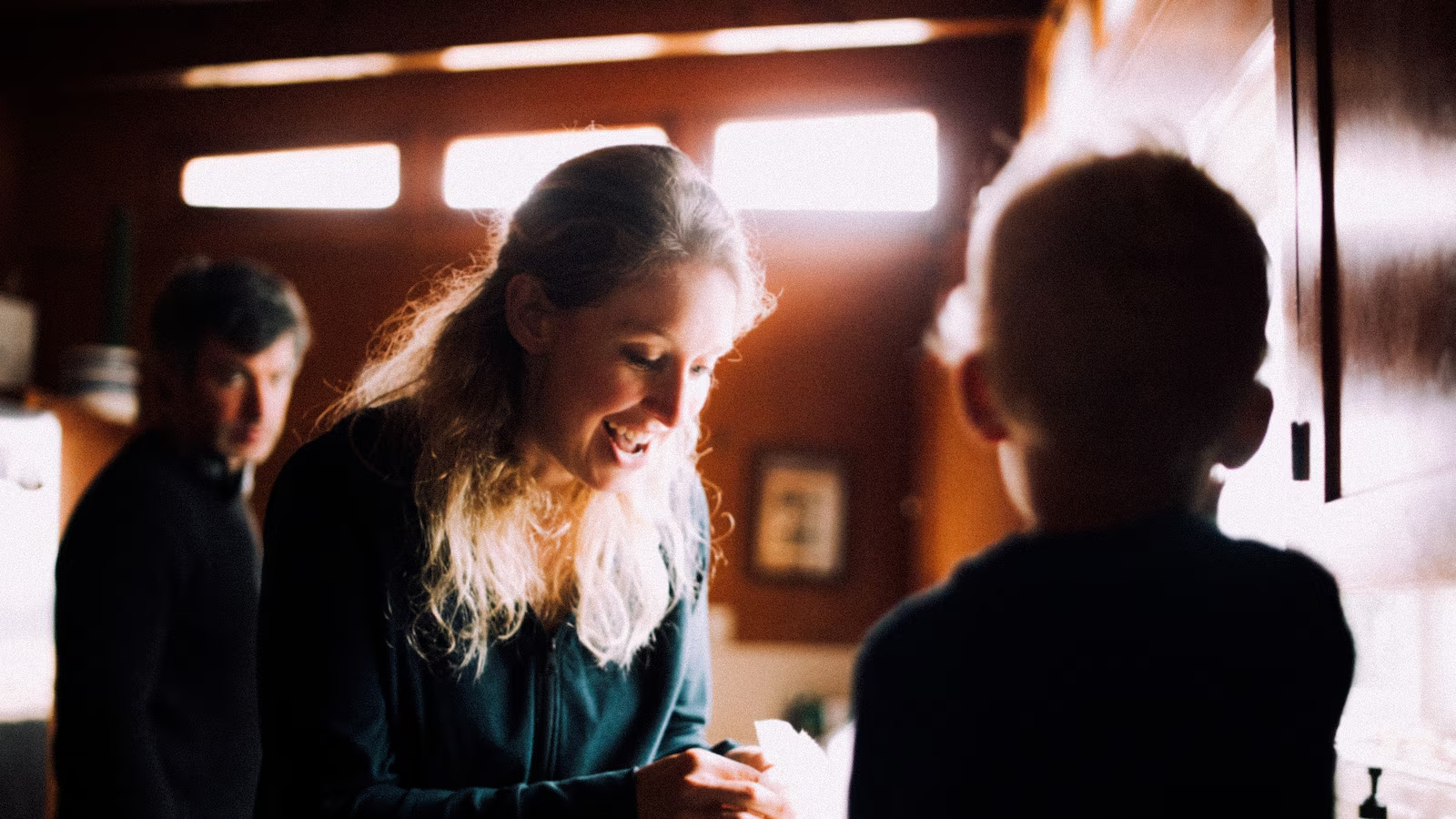
New York — It’s no longer a secret, “You Can See Everything,” Nathan Fielder and Lance Oppenheim’s Elizabeth Holmes documentary, Wednesday at the New York Film Festival.
From its debut in a surprise, phone-free screening at the Telluride Film Festival on September 6, “You Can See Everything” instantly transformed into one of the year’s most exciting films.
Secretly shot over three years, the nearly three-hour documentary captures Holmes, who founded the medical testing company Theranos, in the 34 days before he was reported to prison. But as Fielder fans might expect, there isn’t much about how “You Can See Everything” follows a conventional path.
Moviegoers lined up outside Lincoln Center’s Alice Tully Hall as early as 3 a.m. in hopes of attending the sold-out 8 p.m. screening.
“You Can See Everything,” which A24 will release on October 16, is a hard-to-believe coda to a preposterous saga. Even Fielder isn’t sure what to make of the surreal odyssey he and Oppenheim captured.
“I still struggle to this day to understand what I went through,” Fielder said in Q&After the screening.
After being convicted on four felony counts of fraud and conspiracy, Holmes entered a prison in Texas in May 2023. In a head-scratching scandal that has affected Silicon Valley, one of the most surprising and shocking twists was revealed this month alone.
Holmes chose to let Fielder, the absurdist comedian of “Nathan For You” and “The Rehearsal,” and documentary filmmaker Oppenheim, film her life closely with her partner, California hotel heir Billy Evans, and their two children.
During this amazing time in their lives, Fielder was living in a guest house at their beachside home in Del Mar, California. The filmmakers shot from morning to night. Fielder interviews the couple while they are in bed, or in the bathroom.
“I mean, I can’t tell you how weird it was that we were there,” Fielder said. “I wouldn’t think I’d be the person you’d want for your last 34 days of freedom. I’m not the most comfortable person, as it is.”
The filmmakers happened to hear that Holmes and Evans had contacted A24 about making a documentary. Fielder didn’t initially think it would be a feature film, but it was strange just meeting Holmes.
“When I met her, I remember having this strange experience,” Fielder explained. “She seems so genuine at times but then I’m like, (expletive), checking my thoughts and being like, ‘I know she’s a liar.'”
“Everyone who worked on this film was going through a similar mental dissonance,” said Oppenheim, who directed the “Primetime”, which had just been released, with Robert Pattinson as “To Catch a Predator” guest Chris Hansen. “We would unpack the events of the day and no one could agree on what seemed like bad moments to come up.”
In “You Can See Everything,” Fielder tries not only to understand what is true and what is not true about Holmes, but to engage with deeper questions of identity, performance, fiction, and control.
Holmes co-founded Theranos with her then-romantic partner Ramesh “Sunny” Balwani. They promised that the company would revolutionize healthcare with technology that could quickly scan for infections and other health problems with a few drops of blood taken from a finger pin.
The hype helped them raise nearly $1 billion from investors. By 2014, Theranos was valued at $4.5 billion.
But after the company’s proven technological advances were revealed in a series of explosive articles in The Wall Street Journal, the company collapsed. In 2018, the US Department of Justice charged Holmes and Balwani with a litany of white collar crimes.
Balwani was convicted separately on 12 felony counts of fraud and conspiracy and sentenced to nearly 13 years in a Southern California prison.
The filmmakers asked more than once to the people of Alice Tully Hall to preserve the amazing movements and the turning of the film as it moves. That includes amazing A-list star-sponsored adventures and other analysis, all in an effort to get closer to the truth.
But even as Fielder and Oppenheimer asked viewers not to consider the film too closely, it was clear that they wanted to discuss and try to make sense of “You Can See Everything”.
“Like every scene, it’s happening and we’re documenting it. There’s no plan of what’s going to happen at any given time,” Fielder said. “This is a path that opened up for us and we followed it.”
