 Skip to content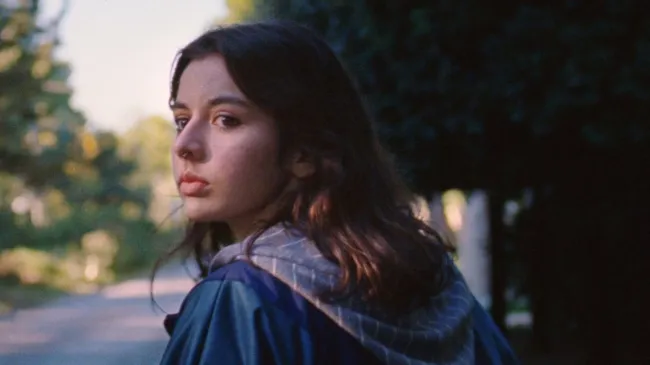
“Send her the dream.”
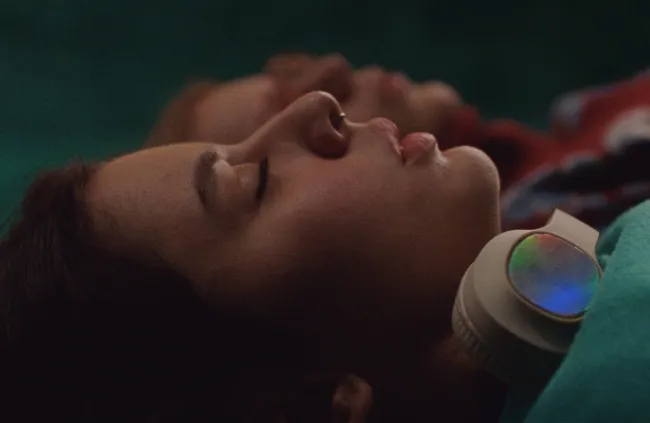
This is how it starts. A teenage girl is lying high in a field of grass, a hand on her belly, her breath filling the soundtrack as if the film itself were in her lungs. Then she is asleep, and a pair of abstract voices – from inside her own mind or perhaps another dimension, whatever the difference – begin to talk about what images should be screened behind her eyelids. Wind blowing. The Colorado Avalanche hat has a wing sticking out on each side for some reason. Bullet case. They debate that last symbol, but in the end they decide it’s okay. The girl still doesn’t know what it means.
How can the voices express such ideas to themselves? Maybe the girl’s life is like a movie they’ve both seen before. Then again, the self-possessed originality that fills every frame of Jacqueline Lentzou’s unforgettable “A Day in the Life of Jo: Phaedra Chapter” makes that idea feel almost impossible. That feeling won’t last. At the end of this profound but ethereal vision of a film, a slim cut of true cinema that defies convention with the lyrical ingenuity of Björk (or another great poet writing in their second language), the possibilities seem as infinite as life itself. Maybe even more so.

Needless to say, the writer-director’s amazing second feature “Moon, 66 Questions” is no ordinary coming-of-age movie, even if it looks like one on paper. The usual signs abound, such as anger and plenty of music (the songs range from Vashti Bunyan and Daniel Johnston to Bryan Ferry and… Vincent Gallo?). Drugs. Dance. Idle gossip. Self-discovery. Making a fuss at school and fighting with mom at home. Everything is influenced by lived experience, and the film’s sketch of a story was inspired by a terrible event in Lentzou’s native Athens when she was a teenager.
But this is for sure No a movie about growing up. Hewing much closer in spirit to Gus van Sant’s “Death Trilogy” malaise than to the iconic survivalist scenario that runs through everything from “The Breakfast Club” to “Lady Bird” (though it somehow feels lighter than either of those films), “A Day in the Life of Jo” is less interested in adolescence as a vulnerability than in a condition vulnerable – as in a vulnerable state. a process of becoming themselves, bringing their identity down to one at the same time as they are pushed towards the infinity of just what this world can hold for them. The restless light in Lantzou’s style stretches that time into a microcosm of life itself, repeating the “temporary achievement” of being a teenager as a soul’s work on Earth.
Maybe that’s more than Jo (Evita Andriopoulou, real as can be) has when she wakes up for school at the beginning of the movie, but some days are like that, I guess. A long shot from God’s point of view – one of the many wonderful images in a film where every frame is interesting and very sad to one degree or another – is watching Jo miss the bus that passes through the sexy suburb of Athens where she lives with her divorced mother (Eleni Vergeti as the frustrated dance teacher Eleni). But Lantzou brings the camera down to ground level to see Jo beat the crap out of the family car when her mother refuses to drive her to town. Jo doesn’t appear to be a violent child, but her body may already know something that her mind won’t learn until later.
At school, a French 10th grader kisses her boyfriend under the stairs and joins her friends in mocking the childish simplicity of an art class project, where they cut small holes in construction paper. Later, or earlier, the square reflection of fluorescent light against the window looks like a rectangular moon floating in a clear blue sky. It is among the first signs that time should not be trusted in a film where people and things tend to disappear completely (the various overlaps between this film and Sandra Wollner’s upcoming “Everytime” create a cosmic serendipity that benefits them both).
In the music class, all the students sing a song in front of their peers, because being 15 isn’t annoying enough already. A shy girl in a thin floral knit sweater – the kind of girl who is suspicious of anyone who wants to be her friend, and the kind of sweater designed to save such girls the trouble of dealing with it – an old ballad that brings Jo to tears for reasons she doesn’t understand. This is Phaedra (Anastasia Gouliamou). She tells Jo about the proper way to breathe (through the belly, not the chest), commiserates with her about not having or close to a father, and makes plans to see a movie together later that night.
In the end, Jo gives her a ghost. Maybe for a reason you could predict, maybe for a reason you already knew. (Cautiously while I am going to preservefrontal, movie. It doesn’t matter. As with everything in “A Day in the Life of Jo,” truth is elusive what it happens to be surrounded by inescapable beauty and wonder how come.
Glimpses of that wonder—and the spectral essence of mutability that attends it—can be found in every scene, some more than others. Nothing here makes sense on its own, but the original pleasure of inventive writing, such as one where a simple camera move transforms the hard floor of Eleni’s dance studio into her daughter’s high school basketball court, is often given a new measure of meaning when this 82-minute film finally reveals its full range. In that case, our attention is retroactively drawn back towards the waste of time and space, and the question of how to show the invisible forces that hold the universe together.
It’s a question that informs every aspect of Lentzou’s storytelling, despite – and as a result of – his elevation. with – the emulsified crack of Grimm Vandekerckhove’s 16mm cinematography, which always seems to be looking for everything that our eyes cannot see. Seemingly determined to ensure that the name of her film eats up the entire portion of characters you could squeeze into a WordPress SEO field, Lentzou uses the opening credits of “A Day in the Life of Jo: The Phaedra Chapter” to subtitle it in addition to “A film about breath, hands, and loneliness (and the lack thereof),” but it’s shot with a look that feels even the most attractive topics feel like a real scene. “Have you ever heard of a person being found after they went missing?” a jaded character asks in response to a news report about a local disappearance. Lentzou would find them anywhere.
It’s somewhat ironic that Jo and Phaedra didn’t follow through on their plan to go to the movies together, since the movie that brings these girls to life tends to speculate about where movie characters might go when they’re not being watched on screen. On the one hand it’s as if they were never here – on the other it’s as if they always were. “The architecture of oblivion is the most detailed,” someone tells Jo shortly after her story becomes disconnected from the world as we know it. “You don’t remember anything, but you remember forever.”
“A Day in the Life of Jo” not only takes place in the cracks of that limited disconnect, but also suggests that everything else does. Lightly light but heavy as the heavens on your soul, Lentzou’s invisible prayer of a motion picture points out that cinema is as infinite as life itself, if only so it can mourn how difficult it is when none of these things have a chance to be as infinite as they should be.
Grade: A-
“A Day in the Life of Jo: Phaedra Chapter” screened at the 2026 New York Film Festival. 1-2 Special will release it in theaters in 2027.
