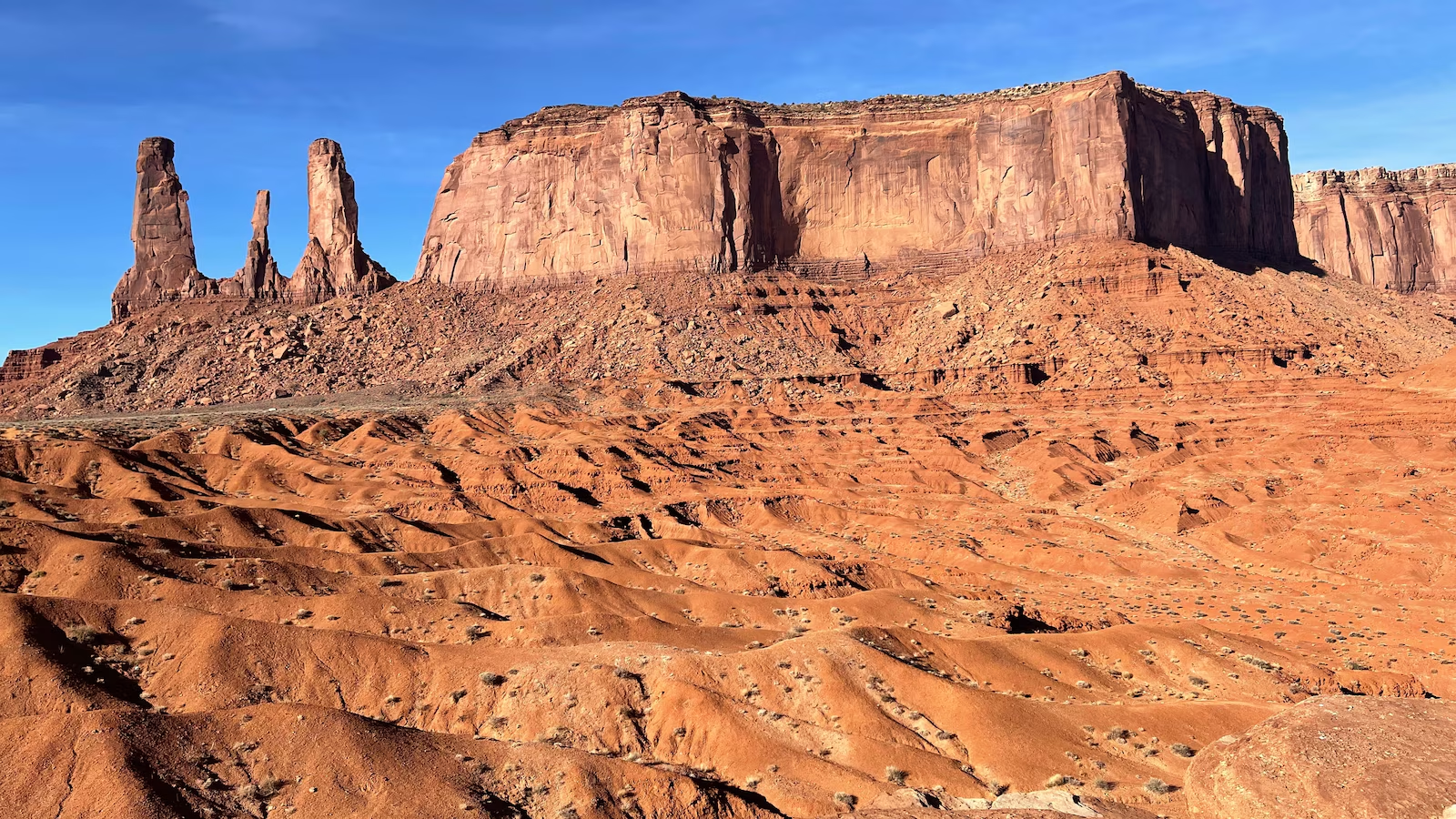
PHOENIX — Spanish explorers called them mesas, meaning tables, when they came across them. But geologically, a mesa is simply a flat-topped mountain or hill. Millions of years of continuous erosion—from the perpetual forces of gravity and wind—have created the iconic mesas of the American Southwest.
For the Native Americans, the original inhabitants of these lands, the rise of the mesas created natural fortifications that provided vantage points and elevated sides that were supposed to protect them from external threats.
They remain sacred landmarks with a deep spiritual connection. Old Oraibi, a small Hopi village in Northern Arizona located on a mesa, is the oldest inhabited community in the United States dating back to 1150.
___
Like so many American icons, mesas lurk in our American collective unconscious from frequent appearances in movies and television—many of which were filmed in Monument Valley, Arizona.
Director John Ford used the dramatic red mesas and knolls of Monument Valley as the backdrop for “Stagecoach” and many more of his Western films. Stanley Kubrick used Monument Valley to set off an alien landscape at the end of the movie “2001: A Space Odyssey”, when astronaut Dave Bowman goes through the Stargate.
Real history is made there too. Robert J. Oppenheimer chose the Los Alamos mesa in New Mexico as the secret place to bring together a group of elite scientists to think about how to split the atom and create the deadliest weapon in human history. To this day, nuclear research continues at the Los Alamos Scientific Laboratory.
___
I was young when I saw my first mesa.
I still remember seeing it from a distance as we drove to Acoma Pueblo, also known as Sky City, in New Mexico. That mesa is 365 feet (111 meters) high. Acoma Pueblo is also one of the oldest inhabited villages in the United States. It had been there for centuries before Hernando de Alvarado, of Coronado’s expedition, came upon it in 1540.
One of my strongest memories of that place is the cemetery at the top of the mesa. It was a clear day when I visited the graves of tribal veterans who fought and died in the US wars. On this same mesa is the Mission of San Esteban del Rey, which was built between 1629 and 1640. All the construction materials for the church, including the earth for the cemetery, had to be carried by foot up the steep mesa.
The strange rock formations created by the mesas reveal the millions of years of this Earth’s age. But for me they also call for the pain of being torn from the land – and the truth that nothing is permanent, that the world is changing forever.
___
Part of a recurring series, “American Objects,” celebrating the 250th anniversary of the United States. For more American products, click here. For more stories about the anniversary, click here.