Skip to content
Considering its subject matter, “The Swan: Behind the Mirror” looks like a documentary that would have been specially designed for Erin Lee Carr, the director behind such horror films as “Mommy Dead and Dearest” and “Britney vs Spears”. But Hulu’s deep dive into Fox’s controversial reality show was in development before Carr was ever attached.
“Actually, [‘The Swan’] it upset all of us,” Carr told TheWrap.
Although “The Swan” only lasted for two seasons, it left an ugly mark on television. The series premiered on Fox in 2004 at the height of the body modification era of reality TV, an era that was home to shows like “America’s Next Top Model” and “The Biggest Loser.” Even compared to that series, “The Swan” was great. Each season took 16 self-proclaimed “ugly ducklings” and promised to transform them into “beautiful swans”, putting them on plans that included extensive plastic surgery, dental work, fat loss surgery and a grueling exercise plan. Over the course of three months – an incredibly short time considering the physical pressures these contestants put on them – these women transformed themselves, living in a controlled environment without mirrors and dependent on the show’s developer; his life coach, executive producer Nely Galán; and each other. Those women who were still recovering were then pitted against each other in a beauty pageant.
Even in the early 2000s, the show was widely criticized for promoting negative body images for women and for the shocking measures its contestants were forced to take. However, the pre-horror series jumped to an average of 9 million episode viewers in its first season.
“I think after the documentary ‘America’s Next Top Model’ [‘Reality Check: Inside America’s Next Top Model’]there was a lot of interest in the subject, and the women had already been waiting 22 years,” Carr said of making the documentary. Of course, it could be in the zeitgeist in six months. But now it feels like perfect timing. It’s a confluence of all these different things that are happening, and it’s time to tell the story of ‘The Swan’.”
Expectation TV, the production company behind the film, had been working on what would become “Behind the Mirror” for years before Carr was ever introduced. Noted for her highly emotional and compelling documentary work, Carr wanted to make sure her commentary on “The Swan” didn’t focus solely on the producers or the cultural impact of this series but instead on the contestants themselves.
“It was about nurturing the relationships with these beautiful people, these women, to create a broad emotional dynamic within the film,” explains Carr. “There have been shows about reality shows – some very successful – but they have often been from the point of view of the producers. Sometimes women’s stories are drawn to one thing. So for this, I had a big, deep feeling that was like, I don’t want to come and do exactly what the show did for them. I was very lucky to work with Beth, who didn’t make me choose four people but gave us all and the producers a chance to tell us.
That care for the contestants’ stories is translated into how each former “Swan” was interviewed and styled for the documentary. The interviews were one of the most impressive aspects of Fox’s original reality show. While these women were recovering from surgery and away from their friends and families, agents would probe aggressive questions with them in the hope of getting an answer. At one point, Season 2 contestant Dore Weber says a cameraman asked her about her infertility problems while she was reading a letter from her sister, who just had a baby.
This kind of aggressive questioning was par for the course on “The Swan,” a show that described making a contestant cry on screen as the “cash-in.” That’s why Carr was especially careful to make sure each contestant felt like they had agency in “Behind the Mirror.”
“Before every interview, I sat at each Swan’s feet, and I said, ‘There’s a societal thing where women feel like they have to answer questions when they’re asked. You don’t have to. This isn’t a reality show…
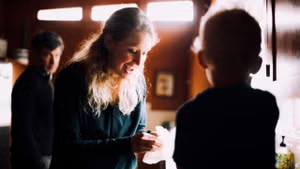
“Behind the Mirror” also had a large female cast, a decision Carr believes helped create a safe environment for her documentary subjects. Each woman even got her own walking song.
“I recommend this to all documentary filmmakers dealing with trauma. You pick your favorite song, we play it in the speakers and everyone claps,” she said. “I want to make you feel like a rock star – confident, cool, listened to – and that’s how we did it, which was so much fun. I’ve never done that before.”
That care even translated into the Swans’ style. As the film explores, “The Swan” ignored the contestants’ preferences before giving them extensive, almost permanent makeovers. Season 1 contestant Tawnya Cooke speculates in the documentary that she was not pushed through to the pageant because she refused to get a nose job. Season 2 contestant Kari Bravata admits she didn’t recognize herself when she was finally allowed to look in the mirror. It was only after she had her makeup, dress and hair extended that she saw herself again. Even more shockingly, Bravata suffered a number of complications after her image-altering surgeries.
“I said this wasn’t supposed to be a real, overdone thing. We’re going to try to keep it as natural as possible. But also, if you want to go crazy, go crazy,” Carr said, noting that the makeup artist for the film – Devan Underwood – “is one of the best makeup artists I know. Carr also asked the women to bring several costumes and designed the curtain behind them depending on which curtain the woman preferred and the costume. The producers for “The Swan” did not have that luxury.
“I don’t know if you caught this, but I put all the producers in front of a red curtain because they had done that to the women,” Carr said.
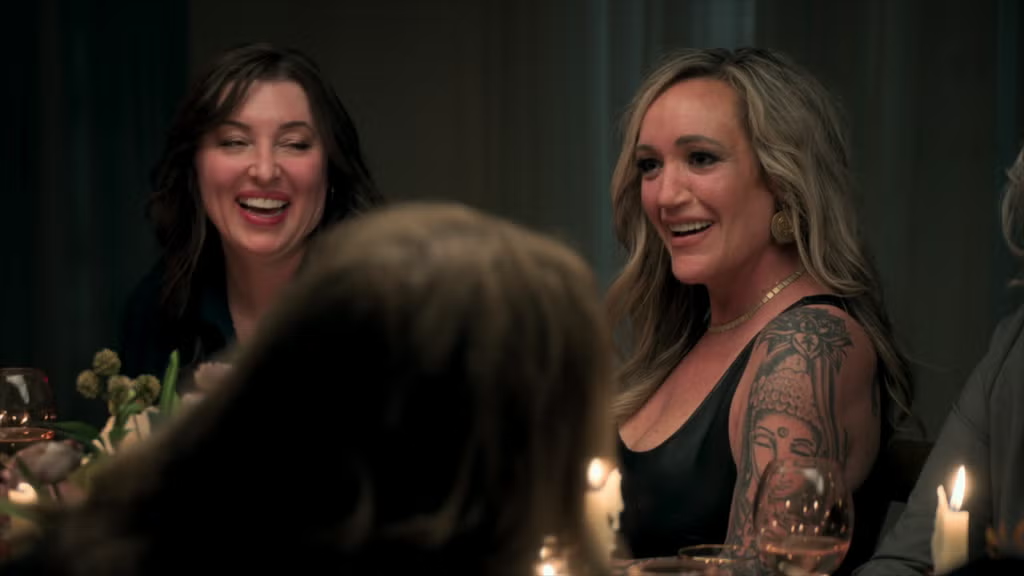
That stark contrast between the contestants versus the producers and on-screen talent is another theme woven throughout “Behind the Mirror.” At one point, Dr. Randal Haworth, one of the plastic surgeons in “The Swan,” calls himself a “plumber,” meaning that he saw the pre-surgery women as toilets. Later in the film, producer Carl Buehl becomes emotional when a woman is crowned the winner of the pageant and says, “That’s why we do shows like this. His surprising statement comes after many contestants have detailed how they feel they are victims of “The Swan”.
“If you sit down for an interview with me, I really appreciate it because it’s so easy to say no,” Carr said. “I think everyone I interviewed felt deeply conflicted about [‘The Swan’] at times. Jenna was there [Baker, a producer]who is a very genuine person. She said that they had a 1% choice in what happened, and she didn’t think that was fair. I don’t think she would have made the third season of it.”
Apart from “Behind the Mirror” which may be remembered for its shocking revelations, it is the end of the documentary that keeps Carr. The doc ends with a reunion between several of the former contestants. Even after spending more than an hour watching these women detail how difficult it was to be on “The Swan,” many of them confidently say that if given the choice, they would do it all over again. That’s because this reality show has made them meet each other.

“I’m thrilled with this movie because I finally got a happy ending. All my movies are so sad,” said Carr, referring to works like “Murdaugh: Death in the Family” or “I Love You, Now Die: The Commonwealth V. Michelle Carter. “I don’t think I could be happier. It almost doesn’t matter [how it’s received]. Sometimes it is so important what the audience feels about this. But for me, I did right by the women, and that’s what we can’t lose as reporters. It’s such a fine line between journalism and documentary, but I don’t want people to go through their trauma and be left with more trauma.”
Carr also hopes this film will put an end to the question that has plagued “The Swan” contestants for decades: Why would you do this?
“This story is for anyone who has felt they don’t like the skin they’re in,” she said. “What I had to do with this film – and I hope we were successful – is answer why. Someone comes into your life and says, ‘You don’t feel good about yourself? We can change everything. We’ll get you a nutritionist. We’ll get you a therapist. We’ll get you a trainer. We’ll do the plastic surgery you want.’ And it was the advent of reality television. People didn’t know how human beings were treated in reality television at the time.
“I had to answer the question: Have you ever felt bad about your body? Imagine that someone came to you with a golden ticket, and instead of that happening, this happened,” said Carr.